



News
View the latest inspiring and positive news and information about what's going on in the PM and IT world.
Why choose E-learning?
Professional development does not have to disrupt your schedule. Our E-learning courses are designed to fit around your work and personal commitments, making it easier than ever to achieve your certification goals.- Flexible learning: study whenever and wherever suits you best
- Short learning moments: make progress, even with a busy agenda
- Trainer support: guidance from experienced professionals throughout your learning journey
- Certification preparation: prepare for internationally recognised certifications
- 12 months access: learn and revisit materials at your own pace
Give your career a boost
The certification you earn today can create opportunities tomorrow. By investing a few hours each week in your professional development, you can strengthen your expertise, increase your confidence, and be ready for new projects, responsibilities, and career opportunities in the months ahead. With the summer period just around the corner, many professionals find themselves with a little more flexibility in their schedules. Why not use that time to earn the certification your future self will thank you for?Make this opportunity count, now
This campaign is available for a limited time only. Explore our e-learning courses and choose the certification that will help you reach your next professional milestone. Start today.
ITIL (Version 5) launches today, representing the newest version of the world’s leading IT Service Management framework. This launch is timed to support organisations navigating unprecedented digital transformation. ITIL (Version 5) moves beyond traditional Service Management paradigms while firmly retaining the foundational cornerstones of effective Service Management.
Key innovations in New ITIL
The new ITIL has been specifically engineered to thrive in today’s fast-changing, AI-driven environment. It offers practical, role-relevant guidance designed to help professionals and organisations consistently deliver measurable value.
ITIL (Version 5) is characterized by:
- Modern, integrated and comprehensive design: ITIL (Version 5) helps teams collaborate more effectively, align priorities and create value consistently.
- AI-native and practical by design: ITIL (Version 5) provides clear, practical guidance for adapting ways of working, making informed decisions and responding to change as technology, business needs and customer expectations evolve.
- End-to-end lifecycle for digital products and services: ITIL (Version 5) helps teams design, deliver and improve digital products and services with greater visibility, stronger collaboration and a clearer understanding of how different stakeholders experience value.
Breaking silos with integrated lifecycles
ITIL (Version 5) tackles one of the biggest challenges organisations face today: disconnected product and service teams. Traditionally, developing a digital product and managing it as a live service were treated as separate, linear activities—often causing delays, miscommunication, and inefficiencies. The new ITIL 5 breaks down these silos with a fully integrated, end-to-end lifecycle, spanning discovery, design, building, testing, transition, operation, delivery, and support.
The result? Faster value delivery, fewer errors, and smoother collaboration across teams. By sharing responsibility for outcomes, organisations can respond more effectively to change, align technology with business priorities, and ensure that every release, deployment, and improvement delivers measurable value.
In short, ITIL (Version 5) does not just update processes—it reshapes how digital products and services are created, managed, and improved in today’s fast-moving, AI-driven world.
Why the new ITIL
When the environment changes the framework needs to adapt accordingly, in order to remain relevant. The main reasons why there is a new ITIL in 2026 are:
- A new digital landscape
- Digital first business models
- The AI revolution
- Greater adaptability
- Stronger interconnection and value focus
- A simpler, clearer qualification scheme
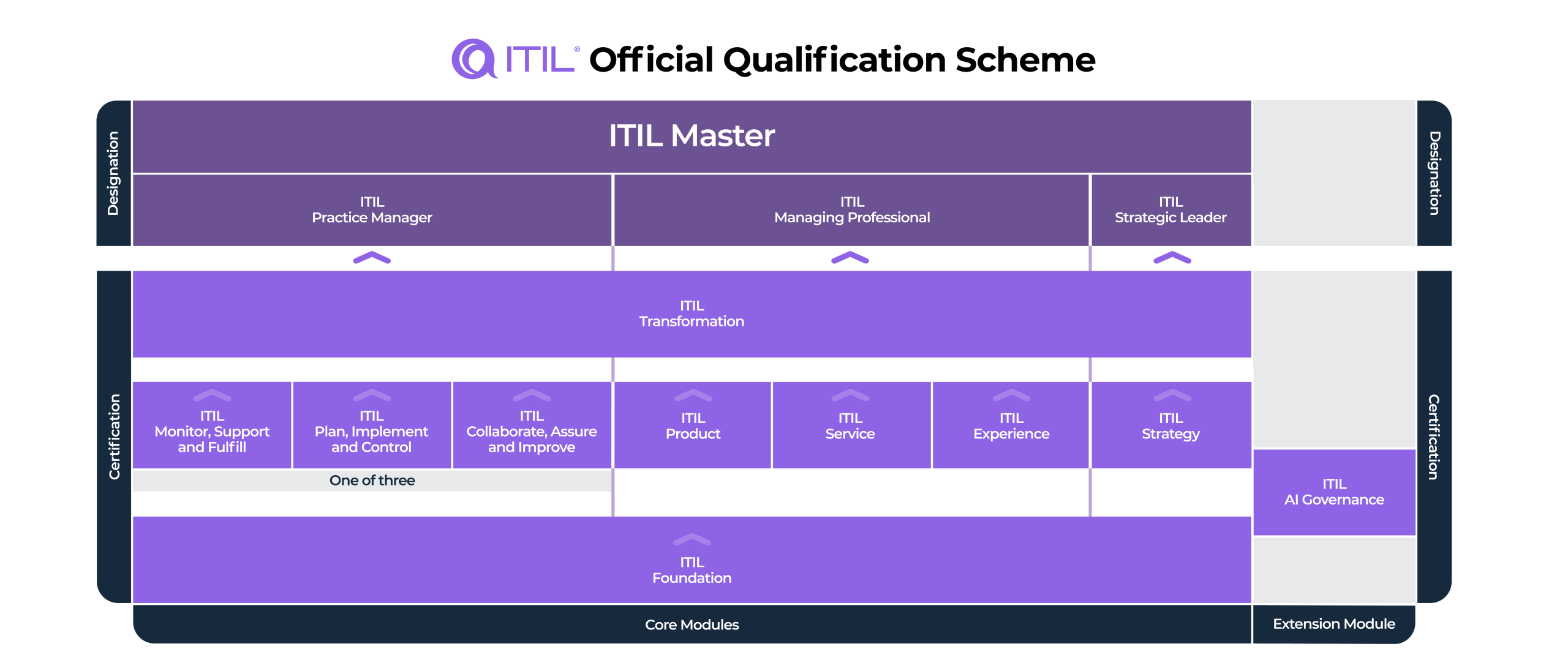
ITIL (Version 5) Official Qualification Scheme
In ITIL (Version 5) the qualification scheme begins with the ITIL Foundation and continues with eight upper-level modules and one extension module.
The ITIL (Version 5) qualification scheme diagram below provides a visual overview of how the certifications and designations fit together and how candidates can progress through the framework.
If you already hold an ITIL 4 Foundation certification—or any ITIL 4 certificate—you do not need to retake Foundation to progress to ITIL (Version 5) upper-level modules. ITIL (Version 5) builds on ITIL 4, and your existing qualifications are fully recognized as prerequisites.
For a quick update on the key changes at Foundation level, you can take the one-day ITIL (Version 5) Foundation Bridge course, which includes a short exam and awards the ITIL (Version 5) Foundation certificate.
From there, you can continue your ITIL journey by selecting the upper-level modules that best align with your role and career goals, leveraging your ITIL 4 experience to connect established best practices with the latest guidance on digital product and service management.
Recently, the Project Management Institute has published the PMBOK® Guide Eighth Edition, a purposefully more practical, evidence-based update to the profession’s reference Guide. This is not a small tweak, it is the most community-informed edition PMI has produced and it brings a clearer bridge between why we run projects, what we do, and how teams should work in today’s context.
PMBOK 8: What Has Changed
The PMBOK® Guide Eighth Edition significantly updates the project management profession, emphasizing value delivery, performance domains, and broad applicability. It includes:
- Six core principles that guide effective project management behaviour
- Seven performance domains that represent key areas of practice
- Reintroduced processes as flexible, non-prescriptive anchors that operate across predictive, adaptive and hybrid approaches to support the performance domains
- Expanded coverage of AI, PMOs, value and sustainability: the Guide now explicitly integrates guidance on value delivery and on technologies and ways of working that matter in modern projects
- Inputs, Outputs, and Tools & Techniques now appear as non-prescriptive items, covering various approaches and referenced across the Guide.
The Practical Implications for Project Managers
The Eighth Edition shifts the conversation from activity-focused metrics to outcome-focused judgement: success is no longer measured only by whether scope, schedule and budget were met, but by whether the value delivered outweighs the effort and expense invested. That subtle reframing pushes organisations to align project activity with strategic outcomes, encouraging teams and sponsors to prioritise benefits and business impact over purely transactional milestones.
PMBOK 8: More Flexibility, Better Results
At the same time, PMBOK 8 gives practitioners the best of both worlds — principled, performance-domain thinking paired with practical “how-to” guidance. The Guide restores process-level guidance, but presents it as flexible, non-prescriptive reference material rather than prescriptive rules. The renewed perspective gives back the “how” to practitioners. This makes it easier for teams operating in predictive, Agile or hybrid environments to adopt patterns that fit their context while keeping a consistent language for governance and stakeholder communication.
The edition also brings urgent, contemporary topics into the core of project practice: explicit guidance on AI with PMI’s new course CPMAI, sustainability, quality integration, PMOs and procurement helps organisations address risks and opportunities they increasingly face. Finally, because the update was shaped by thousands of practitioners, the guidance is more evidence-informed and grounded in what works in real projects: reducing the gap between theory and practice and improving the immediate applicability of the recommendations
Our perspective as Accredited Training Organisation (ATO)
As an external organisation reporting to and serving the project-management community, we welcome PMBOK® 8. It brings a pragmatic balance: sharpening principle-based thinking while returning useful, practical process guidance — and doing so on the backbone of unprecedented practitioner input. For teams focused on delivering measurable business outcomes, this edition provides clearer language and a more contemporary toolkit to navigate value, quality, AI and sustainability considerations..
The updated PMBoK 8 will be integrated in QRP International’s PMP courses in 2026!
Discover our PMP course and certification, and continue your professional development journey with QRP, your partner in continuous learning.
Events across 6 Countries
In 2025, QRP International hosted a variety of events designed to support your learning journey through different formats. We covered Project Management, ITIL, Agility, and Change Management in Belgium, the Netherlands, Luxembourg, France, Italy and Switzerland. Our on-site events bring together like-minded professionals, creating a space for meaningful knowledge sharing. Participants gain access to the latest methodologies, practical tools, and the opportunity to exchange experiences and best practices. In addition, our online events extend and complement this learning journey by featuring expert speakers and providing deeper insights into specific topics.Over 6,000 Professionals Trained
In 2025, more than 6,000 professionals attended our courses. This milestone underscores our continued commitment to supporting individuals and organisations in developing the skills needed to manage change and deliver results.Two New Courses — AIPM and CPMAI
To respond to evolving market demands and the growing role of AI in project management, we introduced two new products: AIPM (AI‑Driven Project Manager) and CPMAI™ (Cognitive Project Management in AI). Adding these courses to our portfolio was a strategic step to ensure our participants have access to the skills and frameworks needed to manage projects and transformations in an AI-enhanced environment. With the rise of AI shaping the way organisations work, these offerings provide essential knowledge to stay ahead. We will continue to expand and support AI-focused learning in the coming year, helping professionals integrate these tools effectively into their projects and decision-making processes.Supporting the Community: Fondazione Maria Letizia Verga
We once again recorded a tangible achievement in our commitment to social responsibility. QRP team members volunteered to wrap and sell Christmas gifts at the Christmas market for the Fondazione Maria Letizia Verga and we donated €6,000 to support their cause: supporting children fighting leukemia. This hits home, as one of our own employees has faced a similar journey.Internal Engagement and Our Network of Trainers
In 2025, our Employee Net Promoter Score (eNPS) reached +65, reflecting strong internal engagement and satisfaction across the company. Moreover, over 100 trainers contributed to delivering our different trainings worldwide — sharing expertise, dedication and practical experience with our participants.Looking Ahead
The results of this year reinforce our belief that development, innovation and community impact go hand in hand. As we move into 2026, we remain committed to providing high‑quality training, expanding our offerings, and supporting growth — both for professionals and organisations. From all of us at QRP International — thank you for being part of this journey. We look forward to working with you next year. QRP International is developing professionals to facilitate changes. Merry Christmas and a successful New Year!
The Comitato Maria Letizia Verga
Founded in 1979 by Giovanni Verga, the father of Maria Letizia, the Comitato Maria Letizia Verga is an association that unites parents, volunteers, friends, supporters, researchers, doctors, and healthcare professionals in an Alliance with a shared mission: to improve the overall quality of life of children and adolescents affected by hematological malignancies diseases, as well as complex therapeutic, metabolic, and genetic conditions. For over 45 years, the Comitato has led numerous initiatives to study and treat childhood leukemia, providing care and treatment to over 2,500 children and adolescents. Thanks to its efforts, the recovery rate has significantly increased — from 30% in 1979 to 85% today. In particular, the Comitato Maria Letizia Verga has:- Invested over €120 million in research, treatment, and patient care;
- Established the Maria Letizia Verga Center, an integrated system designed to address the complex needs of children with leukemia and their families. Located within the IRCCS San Gerardo dei Tintori Foundation, it combines research, treatment, therapy, and support services;
- Built the Maria Letizia Verga Residence, providing accommodation for children and adolescents undergoing treatment at the Center, along with their families;
- Promoted the creation of the Tettamanti Research Center and the Monza and Brianza Foundation for Children and Mothers;
- Established the Stefano Verri Cell and Gene Therapy Laboratory, a cell factory inaugurated in 2003 in collaboration with the Tettamanti Foundation and the Stefano Verri Committee.
Many professionals already ITIL Foundation certified struggle in the selection of the next step in the ITIL Intermediate certification path. What is the next step to improve your IT service management skills? With the info and the guide below we want to explain in easy words the ITIL certification path: the different options available, the credit system and the steps that will guide you to become an ITIL Master.
Why continue your training after ITIL Foundation?
In today’s fast-paced and demanding digital landscape, IT leaders and professionals must deliver high-quality services with greater speed and agility to remain competitive. In order to successfully face all these challenges, there is only one imperative: improve skills.
This is where ITIL comes in: ITIL can provide a practical and flexible basis to support organisations on their journey to the new world of digital transformation.
Continuing beyond the Foundation level allows professionals to deepen their knowledge, specialize in key areas and apply ITIL principles in ways that drive meaningful improvement and long-term value across their organisation.
What about the ITIL Intermediate Levels?
To start off it is very important to underline that all ITIL Intermediate certifications are available only to ITIL Foundation certified professionals. In other words, the ITIL Foundation certificate, version 3 or 4, is the prerequisit in order to access any intermediate level.
You can continue your ITIL journey with three different paths:
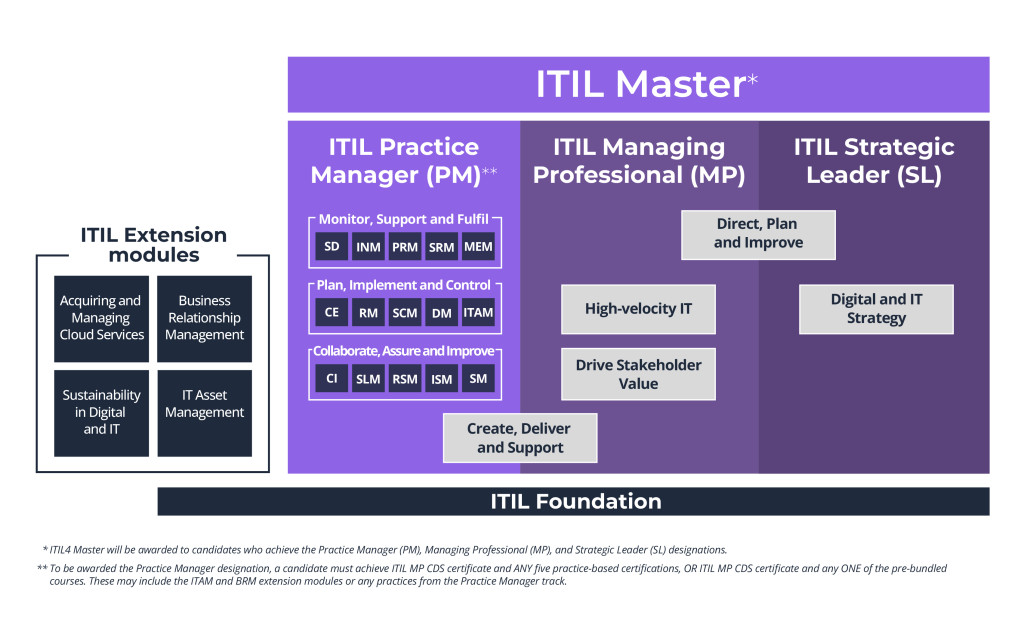
If you achieve the Practice Manager (PM), Managing Professionals (MP) and Strategic Leader (SL) designations, you will be entitled the ITIL Master level.
1. ITIL Practices courses are intended for professionals who want to prove and validate their skills in specific practice areas or establish a good cross-practice collaboration and effective service value streams with practical assignments built into the courses. To achieve the Practice Manager designation, you need to have completed 5 individual practices plus the ITIL Specialist: Create, Deliver and Support module (common module between ITIL MP and ITIL PM). ITIL Practice Manager consists of fifteen practices courses, divided in three combined courses:
- ITIL Monitor, Support and Fulfil
- ITIL Collaborate, Assure and Improve
- ITIL Plan, Implement and Control
2. The ITIL Managing Professional Stream modules are relevant for IT practitioners working within technology and digital teams across business. The Managing Professional (MP) stream provides practical and technical knowledge about how to run successful IT-enabled services, teams and workflows. The ITIL Managing Professional Stream modules are:
3. The ITIL Strategic Leader modules recognize the value of ITIL, not just for IT operations, but for all digitally-enabled services. Becoming an ITIL SL demonstrates that you have a clear understanding of how IT influences and directs business strategy.
The ITIL Strategic Leader modules are:
See the image below for an overview of the ITIL 4 Certification Scheme.
Source: PeopleCert
ITIL Training
QRP International is an accredited training organisation (ATO) for ITIL. Check our ITIL training formats and pick the one that suits your needs or works best for your colleagues: ITIL Training.
Not sure which module is right for you? Want to train your entire team? Contact us and we’ll help you find the best path forward.
Interested in learning more about ITIL? Don’t miss our ITIL blog posts for insights, updates, and practical guidance.